A partnership opportunity for the United States · September 2026
An opportunity to support a major maternal health initiative: giving American women access to pregnancy and breastfeeding support, while helping establish an independently governed research program that measures what actually happens to them over time.
The problem
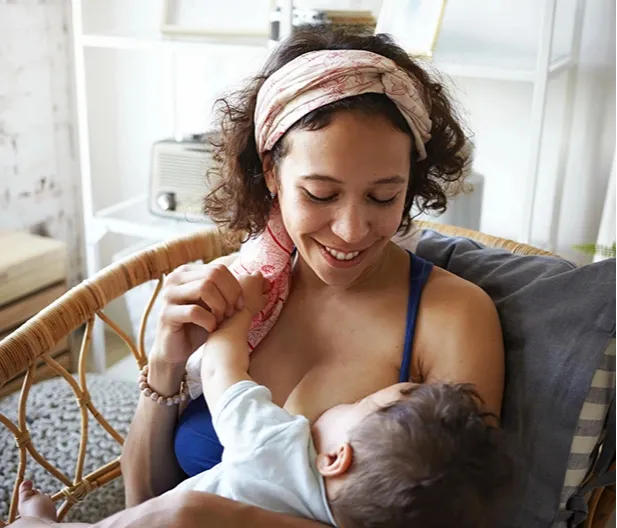
In a CDC-led study of more than 1,100 mothers, around six in ten who stopped breastfeeding had stopped earlier than they wanted to.
The distance between the feeding a woman intended and the feeding she achieved has a name: the Intention Gap. It is not a matter of choice. It is a matter of preparation, support, and when that support arrives.
Those mothers were followed almost twenty years ago. In 2026, a review of 55 studies found that not one had made the Intention Gap its main outcome. Next 10,000 does.
Sources: CDC National Immunization Survey, infants born in 2022. Odom et al., Pediatrics, 2013. Saito et al., BMC Pregnancy and Childbirth, 2026.
The shift
Maternal health is finally being taken seriously in America. In September 2026, Olivia and Tom Walton committed an initial US$100 million to halve maternal deaths in the United States by 2031. Health systems, insurers and employers are moving in the same direction. This is good news, and it is overdue.
The country has set its own goal: 42.4% of babies exclusively breastfed at six months by 2030. Today it sits at 28%.
The research has set out what good support looks like: continuous, connected care that does not reset between pregnancy, hospital, home and the return to work. Breastfeeding sits at the center of both maternal and infant health, and it appears twice in the plan behind that hundred million dollars.
The specification is written, and we already run it. What is missing is the evidence at scale, and that is what Next 10,000 produces.
The opportunity
Ten thousand pregnant women, prepared before birth with The Thompson Method and supported daily through My Milk Map. Within that program, American women who choose to take part form an implementation study, run under independent institutional review board (IRB) approval in the United States. Women in the study take part at no cost.
Each woman is measured against her own stated intention rather than against other mothers, and followed for twelve months from birth. The result is a full year of prospective maternal and infant health data of a kind that does not currently exist in the United States.
No woman will be enrolled in the research until IRB approval is granted.
Why us
Dr Robyn Thompson PhD OAM, 1944 to 2025.
We are not starting from scratch. The Thompson Method began with Dr Robyn Thompson's PhD on nipple trauma, continued through the research program at Mater Mothers' Hospital in Brisbane, Australia, from which the method developed, and has been published twice: in Women and Birth in 2016, and independently by Allen and colleagues in the International Journal of Nursing Studies in 2023, across 13,667 mother and baby pairs. Professor Sue Kildea is a co-author across that body of work.
Then we took it to the world. One hundred thousand women over eight years, across the United States, Canada, Australia and beyond, with the support model rebuilt each year around what those women said they needed. My Milk Map is the result. Today, around half of the women we support are in the United States and Canada.
The method is proven. The delivery is proven. What has never been done is running both together, at scale, and measuring it properly.
The film
Most research ends in a journal. The findings of Next 10,000 will go to governments, health systems and hospital policy makers, to change how women are supported before and after birth. That work matters, but it can be a slow process.
This research has something most research rarely gets: a feature documentary. WHAT THEY KNOW tells the story of Dr Robyn Thompson's life's work, narrated by a two-time Academy Award winner (name withheld) and currently in development.
The film turns percentages into people. The Intention Gap stops being a statistic and becomes a woman who planned to feed her baby, and what changed when she was prepared before birth. The film carries what is already proven. The study produces what is still missing. Together they reach the women who need it now, while we sit at the table with policy makers.
Research builds the case institutions can fund and adopt. The film builds the culture that makes adoption possible.
The draft treatment for WHAT THEY KNOW. WHAT THEY KNOW is a working title.
As a sponsor, you will be acknowledged in the film's credits as a backer of the Next 10,000 research. Separate partnership opportunities connected to the film will be shared as the production takes shape. No partnership, at any level, carries creative control over the film.
The fit
Four kinds of partner. One shared customer: the American woman preparing to feed her baby.
Low rates of breastfeeding add more than $3 billion a year to U.S. medical costs for mothers and children. The cheapest prevention window in a member's life starts before birth, and almost nobody is covering it. Next 10,000 measures what happens when someone does.
One-day absences to care for a sick child happen more than twice as often when infants are not breastfed, a finding cited by the CDC. The first year back is also when experienced women quietly leave. Backing Next 10,000 builds the evidence for keeping them, and the program the women receive, My Milk Map, is one your people can use directly as a benefit.
Pregnant women and new mothers already shop with you, week in, week out. They are being sold to in a category where almost nobody is supporting them. This is not an audience to acquire, it is one to serve.
Your customers are these mothers, at the moment trust is formed. Backing independent evidence places your brand alongside the support she remembers, not the advertising she scrolls past.
What a partnership supports
Every US$100 brings one woman into Next 10,000: prepared through the program and, if she chooses to take part, measured in the study.
That single contribution covers everything above. You choose how many women you bring in, from one community to a full cohort, and we will talk through what makes sense for you.
What a partner receives
Named acknowledgement on the project platform and in project communications, as a supporter of independent maternal health research.
Aggregate reporting on the reach and impact your support enabled: how many women, where, and what changed for them.
Support that goes directly to women who would not otherwise receive the program.
Your name alongside a prospective cohort built around the question no study has yet made its main outcome: the Intention Gap.
The opportunity to communicate the partnership through your own health, wellbeing and community channels.
Briefings on research findings as they become available, while remaining independent from the scientific process.
Credited in WHAT THEY KNOW as a backer of the Next 10,000 research.
The reassurance
Commercial funding of research is common and, provided it is transparent and appropriately managed, does not in itself stand in the way of ethics approval. The principles are straightforward: the funding relationship is disclosed, and the funder does not control the study design, the analysis, the interpretation, or the publication of results.
Built in from the start, because we have a commercial interest in the result and the Index will be making public arguments about data quality:
The same separation applies to the film. Sponsors are credited as backers of the research, never given a say in the story.
A partner can be recognized as a funder without controlling what the research finds or how it is reported. That separation is what makes the recognition worth having.
Not a fixed proposal. We would like to understand whether this is the kind of initiative you would want to be part of, and how many women you would want to bring in. We can build the right partnership around that.